
30 Sep, 2026
Inventory Management Software vs Manual Tracking: Smart Choice for Growth
Introduction
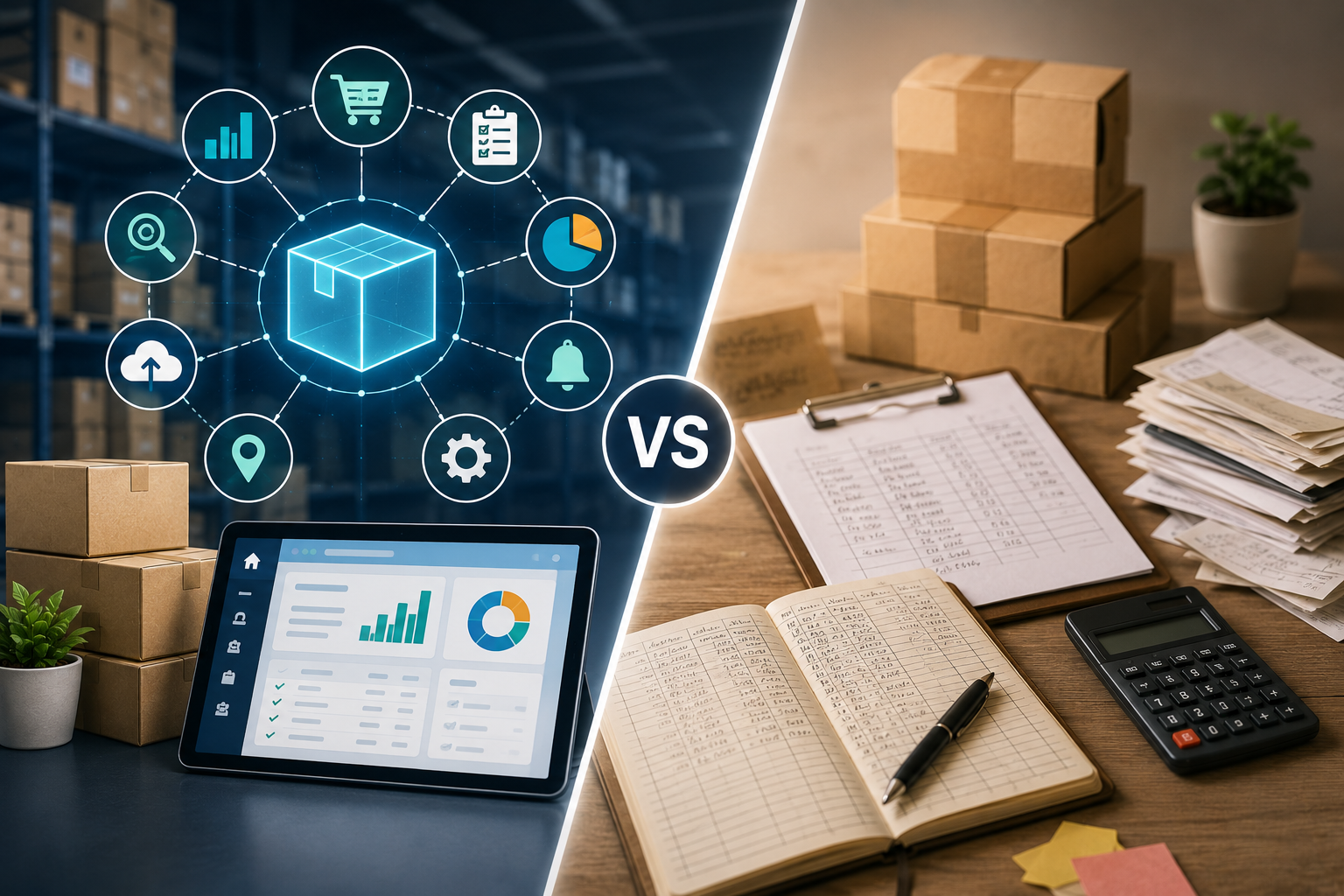
Inventory Management Software vs Manual Tracking is an important comparison for businesses that want to grow efficiently. As your business expands, managing customers, staff, and inventory with manual records becomes difficult, making inventory software the smarter choice.
You might think you are doing fine. But there is a huge difference between "getting by" and truly scaling. Manual systems rarely support the rapid expansion every owner dreams of. Deciding on this path is not just about technology; it is about how you want your business to function as it moves into the future.
In this guide, we explore both paths to help you decide. Whether you are a small local shop or a scaling brand, understanding the topic will empower you to make an informed decision. Let’s break down the reality of managing inventory in today's fast-paced market.
✨ What Is Inventory Management Software?
It is a digital solution that automates tracking stock, orders, and sales. It acts as a central hub, replacing messy spreadsheets with a unified system. When you look at how these systems organize data, the strategic importance of comparing Inventory Management Software vs Manual Tracking: Smart Choice for Growth becomes very clear.
✅ How It Works
It connects sales channels with warehouse data. Every time a product is sold, the system automatically updates your inventory count, keeping numbers accurate without manual effort.
✅ Key Features
It offers real-time tracking and automated alerts. These features make it clear why comparing Inventory Management Software vs Manual Tracking Smart Choice for Growth is essential for leaders.
✨ What Is Manual Inventory Tracking?
This is the traditional way of managing stock using physical ledgers or simple spreadsheets. You record every movement manually, meaning data accuracy depends entirely on your diligence. When you analyze Inventory Management Software vs Manual Tracking: Smart Choice for Growth, it is evident that while manual methods offer simplicity, they quickly become an anchor that limits operational speed.
✅ How It Works
You manually record every item that arrives or leaves. A dedicated person must update the count whenever a sale occurs or a shipment arrives.
✅ Common Challenges
It relies on human memory and constant vigilance. When you look at Inventory Management Software vs Manual Tracking: Smart Choice for Growth, the fragility of this method is obvious as volume increases.
✨ Inventory Management Software vs Manual Tracking: Key Differences
Both methods aim to track stock, but their execution differs. Understanding the Inventory Management Software vs Manual Tracking: Smart Choice for Growth dynamic is key. Software uses automation, while manual tracking relies on human-led verification.
✅ Accuracy and Error Reduction
Software removes math mistakes. Humans get tired, but software is consistent. When analyzing Inventory Management Software vs Manual Tracking: Smart Choice for Growth, digital tools clearly provide higher precision.
✅ Speed and Efficiency
Software updates in the blink of an eye. Manual processes create bottlenecks. Evaluating Inventory Management Software vs Manual Tracking: Smart Choice for Growth shows that manual methods often delay your response to customers.
✨ Benefits of Inventory Management Software
Using software is a strategic advantage that transforms your warehouse into a data-rich environment. With automation, you operate on real-time data rather than outdated reports. This clarity allows you to optimize storage and ensure popular products are always available, which is the defining benefit of Inventory Management Software vs Manual Tracking: Smart Choice for Growth.
✅ Real-Time Updates
You always know what is on your shelves. This is a primary benefit when considering Inventory Management Software vs Manual Tracking: Smart Choice for Growth.
✅ Better Decision Making
Data provides a roadmap. By looking at Inventory Management Software vs Manual Tracking: Smart Choice for Growth, you realize software highlights trends, helping you buy and sell smarter.
✨ Limitations of Manual Inventory Tracking
Manual methods have a "ceiling" of productivity. As you attract more customers, time spent updating records is time taken from high-value tasks like marketing. Manual logs are also prone to errors that take hours to fix. When debating Inventory Management Software vs Manual Tracking: Smart Choice for Growth, consider the long-term impact on your team's focus.
✅ Time-Consuming
Manual counting steals time from core business activities. In the Inventory Management Software vs Manual Tracking: Smart Choice for Growth debate, this is a major loss.
✅ Higher Risk of Errors
Mistakes in logs ripple through the business. This risk is why Inventory Management Software vs Manual Tracking: Smart Choice for Growth is so important for stability.
✨ Which Businesses Should Use Inventory Management Software?
Any business wanting to scale needs to move beyond basic tools. It is the most critical tool for SMEs that need a competitive edge. Choosing Inventory Management Software vs Manual Tracking: Smart Choice for Growth often decides if a business can survive the transition to a larger player.
✅ Small and Medium Businesses
SMEs benefit early by avoiding massive system overhauls later, making the Inventory Management Software vs Manual Tracking: Smart Choice for Growth choice vital.
✅ Retail and Wholesale
Wholesalers specifically benefit from the automation inherent in this Inventory Management Software vs Manual Tracking: Smart Choice for Growth comparison.
✨ How to Choose the Right Software
Choosing software is a critical investment. Look for a user-friendly interface that integrates with your existing tools like accounting platforms. Seek scalable features so you can grow without switching providers. Navigating the Inventory Management Software vs Manual Tracking: Smart Choice for Growth landscape requires prioritizing long-term functionality.
✅ Features to Look For
Seek integrations and easy dashboards. Understanding these helps you navigate Inventory Management Software vs Manual Tracking: Smart Choice for Growth with confidence.
✅ Budget and Needs
Don't overspend on unused features. Your goal in the Inventory Management Software vs Manual Tracking: Smart Choice for Growth process is to solve pain points efficiently.
✨ When Manual Tracking May Still Be a Good Option
For a brand-new business with one product, simple manual tracking can work as a "testing phase." However, always keep the Inventory Management Software vs Manual Tracking: Smart Choice for Growth trade-off in mind, because as demand increases, the transition to software becomes necessary.
✅ Small Operations
If you sell one product, a notebook is fine. The Inventory Management Software vs Manual Tracking: Smart Choice for Growth choice leans toward simplicity for now.
✅ Low-Volume Businesses
If you run a seasonal pop-up, manual tracking might work. However, keep the Inventory Management Software vs Manual Tracking: Smart Choice for Growth trade-off in mind for future expansion.
✨ How Software Supports Growth
Growth requires handling more demand with less stress. Software automates routine work, freeing your bandwidth for strategy. This is a major win in the Inventory Management Software vs Manual Tracking: Smart Choice for Growth evaluation. Furthermore, reducing operational costs through better purchasing acts as an injection of capital into your business.
✅ Improves Productivity
When software handles "busy work," your team focuses on growth. This is a win in the Inventory Management Software vs Manual Tracking: Smart Choice for Growth evaluation.
✅ Reduces Costs
Waste is expensive. By preventing stockouts, software saves money. This financial efficiency makes Inventory Management Software vs Manual Tracking: Smart Choice for Growth a fundamental way to boost profit.
Conclusion
The path you choose will shape your future. Manual methods provide a start, but quickly become a cage that limits your potential. As we explored, the Inventory Management Software vs Manual Tracking: Smart Choice for Growth decision is about choosing between staying small or preparing for scalable success.
By automating data, you gain clarity. You move from "managing" to "leading." Whether you are struggling with spreadsheets or just starting, keep the Inventory Management Software vs Manual Tracking: Smart Choice for Growth framework in mind as you plan your move. It is about building a system that works for you, not one you have to work for.
Transitioning to software can feel daunting, but the long-term rewards are well worth the effort. Now that you understand the core differences, you are fully equipped to make the choice that will propel your business toward its next big goal and ensure sustainable, long-term profit in a competitive market.
Reach out team of Retiva today! 🚀💡📌
FAQs
What is the main benefit of inventory software?
It automates tracking and provides real-time data. This eliminates manual errors and saves your team hours of repetitive work, allowing you to focus on growing your business.
When should I switch to software?
If your spreadsheets feel overwhelming, you notice frequent stock errors, or you are losing sales due to inaccurate counts, it is time to upgrade to a digital system.
Can manual tracking stay effective?
Only for very small, low-volume, or seasonal businesses. As your sales increase, manual methods become a bottleneck that limits your ability to scale efficiently.
Does software actually save money?
Yes. By preventing costly overstocking and unexpected stock outs, it optimizes your cash flow and ensures you are only investing capital in products that sell.
What features should I prioritize?
Look for a user-friendly design and seamless integration with your existing tools, such as your accounting or e-commerce platforms, to ensure a smooth, scalable workflow.
Leave a Comment Here
Your email address will not be published*
Recent Posts



0 Comment